How to Review AI-Generated Code Before You Merge It
Why Review Became the Slow Part
A pull request lands with 600 changed lines and a description that says “add retry logic”. Everything compiles. The tests pass. The author looked at it for about ninety seconds.
This is the review problem that arrived with AI coding assistants. Writing code stopped being the slow part, so the queue moved downstream to the person who has to approve it.
The old review habits assume a human wrote every line and can explain each one. That assumption no longer holds, and reviews that ignore the shift tend to wave through code nobody actually understands.
This guide sets out a workflow that separates what a machine should check from what only a reader can judge, and shows how to scale the effort to the risk of the change.
Automate the Mechanical Checks and Read for Intent
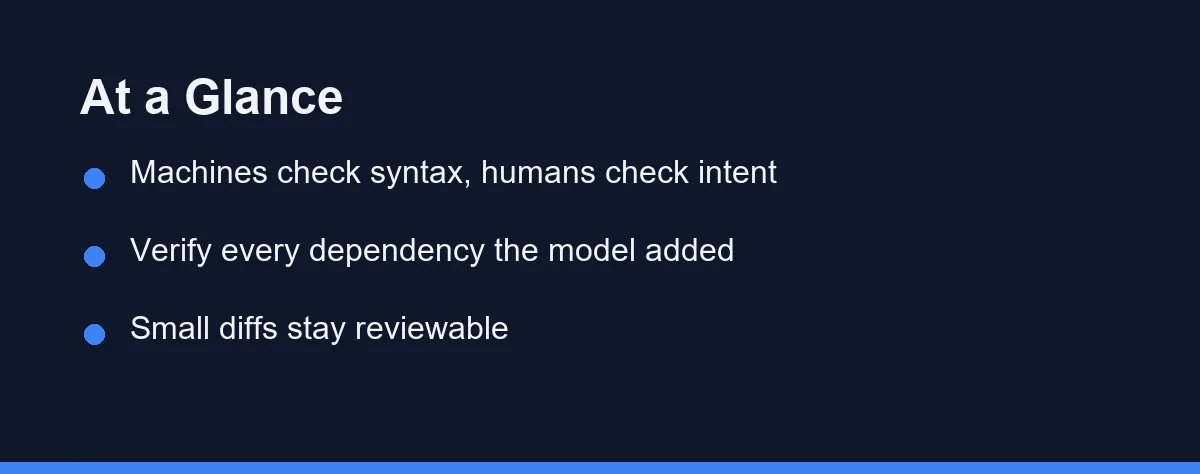
Push every mechanical check into automation and spend your attention on intent. Compilers, type checkers, linters, tests, and dependency scanners find the errors that a careful reader would find slowly. They run in seconds and they never get tired at line 400.
Then read the diff for three things a tool cannot see. Does the change match the requirement, does it respect the contracts of the code around it, and does it touch anything that carries real consequences such as money, credentials, or user data.
Finally, insist on small diffs. Review quality falls off a cliff past a few hundred lines, and assistants make oversized changes effortless to produce.
Why AI Code Needs a Different Read
Human mistakes and model mistakes cluster in different places. A tired developer writes an off-by-one error or forgets a null check, and reviewers have decades of practice spotting that.
A model produces something else. The code reads well, follows local conventions, and solves a slightly different problem than the one in front of it. The mismatch hides in the assumptions rather than the syntax.
Three failure shapes show up repeatedly. The assistant invents an API that would be reasonable but does not exist in your version of the library. It writes code against a stale idiom from years-old training data. It silently drops an edge case the prompt never mentioned, such as an empty list or a timezone.
None of those look wrong on the page. That is exactly why the reviewer’s job shifted from proofreading to interrogation.
The Four Places a Generated Diff Breaks
Start with the boundary of the change. Ask which callers depend on the modified function and whether the new behaviour still satisfies them, because assistants optimise the code in view rather than the system around it.
Check error handling next. Generated code frequently swallows exceptions, logs and continues, or retries an operation that was never safe to repeat. A retry on a payment charge without an idempotency key is a real outage waiting for traffic.
Look hard at anything touching identity, permissions, or secrets. Models will happily write an authorisation check that reads the user ID from a request body, which is the kind of flaw that ships quietly and gets found by someone else.
Then read the tests as a separate artifact. Tests written by the same assistant that wrote the code often assert the implementation rather than the requirement, so they pass by construction and prove nothing.
What Each Review Layer Catches and What It Misses
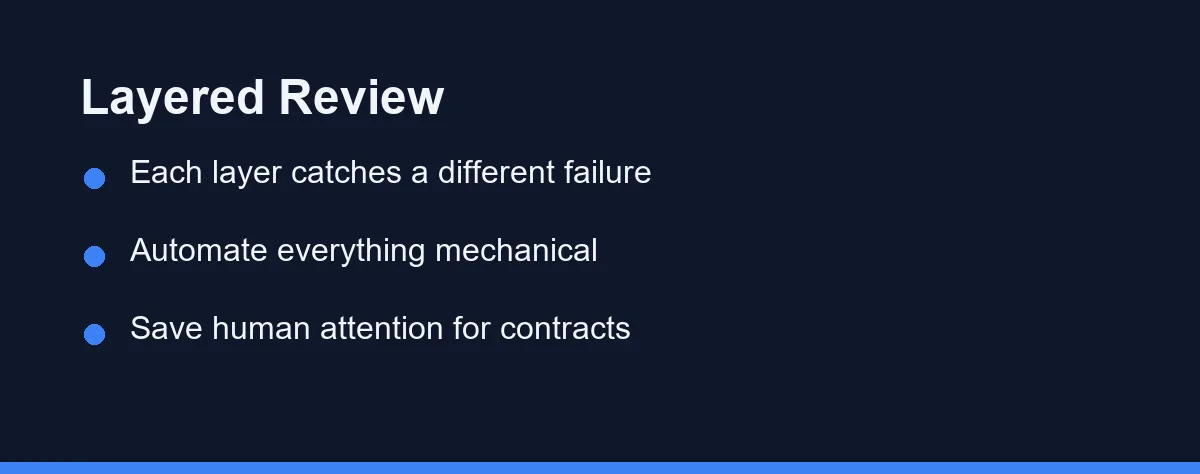
Different review layers catch different failures, and the value of the workflow comes from stacking them rather than choosing one. The table below maps each layer to what it reliably catches, what it cannot see, and whether it belongs in continuous integration or in a human read.
| Review layer | Catches reliably | Blind to | Typical cost | Automate in CI |
|---|---|---|---|---|
| Compiler or type checker | Missing symbols, wrong signatures, invented APIs | Correct types with wrong logic | Seconds | Always |
| Linter and formatter | Style drift, unused code, risky patterns | Anything semantic | Seconds | Always |
| Existing test suite | Regressions in covered behaviour | Untested paths, new edge cases | Minutes | Always |
| Dependency and license scan | Unknown packages, vulnerable versions | Legitimate but unnecessary additions | Seconds | Always |
| Static security analysis | Injection, hardcoded secrets, unsafe defaults | Business-logic authorisation flaws | Minutes | Usually |
| Human read for intent | Requirement mismatch, broken contracts | Subtle performance issues at scale | 10 to 40 minutes | Never |
| Runtime check in staging | Integration and configuration failures | Rare production-only conditions | Hours | Partly |
Read the second column as a division of labour. Everything above the human row is cheaper and more consistent than a reviewer, so a team that spends attention there is wasting its scarcest resource.
The bottom two rows are where AI-assisted changes actually break. Authorisation logic and integration behaviour both depend on context the model never had.
Match Review Depth to Blast Radius
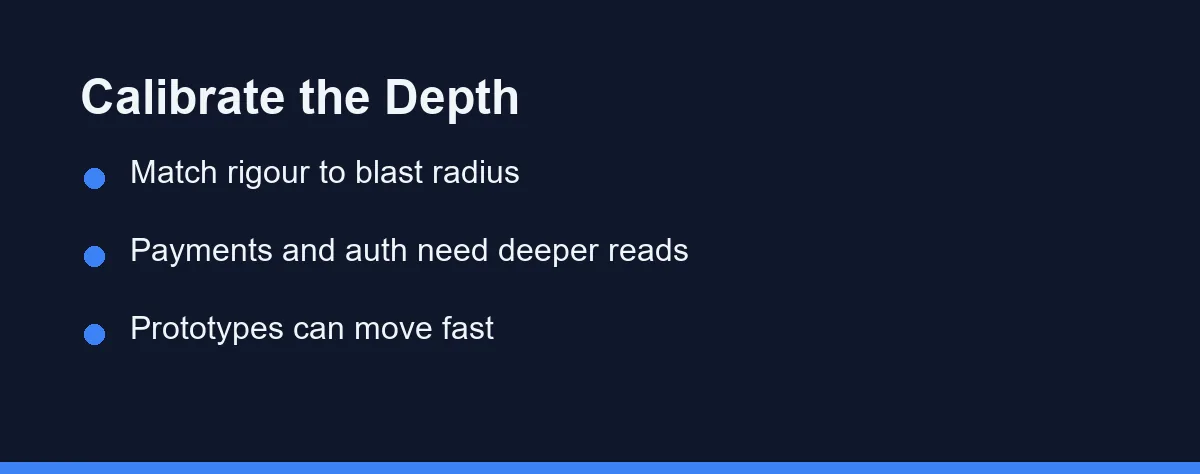
Match review depth to blast radius rather than to line count. A change to an internal script and a change to the checkout flow deserve very different treatment, even when the diffs look similar in size.
Consider who is accountable when the change fails. If the reviewer will own the incident at two in the morning, the review needs to be deep enough that they could rewrite the code themselves.
Factor in how well the surrounding area is covered. Well-tested modules with clear contracts tolerate faster review, while a legacy corner with no tests needs the human read to carry the whole load. Our guide to using an AI assistant on legacy code covers how to build that safety net first.
Decide as a team where automation sits, and write it down. Teams that leave the standard implicit end up with one reviewer doing forensic reads and another approving on green checks alone.
Verdicts by Use Case
Solo developer on a side project: Lean on the type checker and a small test suite, then read the diff once for intent. Skip the ceremony, but keep dependency verification, since a single bad package install is the failure that hurts most.
Small team shipping a production web app: Require a green pipeline plus one human read focused on contracts and error handling. Cap pull requests at a few hundred lines and ask the author to explain the change in the description rather than pasting the prompt.
Regulated environment such as fintech or health: Add license and provenance review to every AI-assisted change, and record who approved it. Confirm the vendor’s data-handling and indemnity terms before adoption, since procurement will ask. Our overview of AI coding assistant privacy and security walks through the questions worth raising.
Open source maintainer receiving outside contributions: Ask contributors to disclose assistant use and to keep changes narrow. Unreviewed generated patches consume maintainer time faster than they add value, and licensing provenance matters more in public repositories.
Team onboarding junior developers: Treat review as teaching rather than gatekeeping. Ask the author to walk through why the generated approach works, because a developer who cannot explain the diff has not learned from it.
Large monorepo with many owners: Route changes by directory ownership and lean on codeowners rules. The risk here is a plausible change that violates a convention only one team knows about, which no linter encodes.
What the Tooling Stack Costs to Run
Most of this workflow costs engineering time rather than licence fees. The tooling tiers below outline what teams typically assemble, and the useful comparison is coverage against maintenance burden rather than sticker price.
| Setup | What it includes | Ongoing effort | Best fit |
|---|---|---|---|
| Free baseline | Compiler, open-source linter, test runner, registry audit command | Low | Solo and small projects |
| Hosted CI free tier | The above running automatically on every push | Low to medium | Small teams |
| Managed code quality service | Static analysis, coverage tracking, review dashboards | Medium | Growing engineering teams |
| Security platform | Dependency scanning, secret detection, license inventory | Medium | Regulated or customer-facing products |
| AI review assistant | Automated first-pass comments on the diff | Low, plus tuning | Teams with heavy review queues |
Confirm current pricing on each official site, since vendors move features between free and paid tiers regularly. Terms as of 2026 vary widely by repository count and contributor seats.
The genuine cost sits elsewhere. Review time per engineer rises when generation gets cheaper, and teams that never budget for it simply approve faster instead. That trade shows up later as defects, not as a line item.
A Ten-Minute Review Pass
Reviewers need a repeatable order, because reading a diff top to bottom rewards whatever appears first rather than whatever matters most. The sequence below front-loads the questions that catch real defects.
Read the pull request description before the code. If it does not say what the change should do and why, send it back, since a reviewer cannot verify an intent nobody stated.
Open the test diff second. New tests reveal what the author believed the code should do, and missing tests on a behavioural change tell you the same thing more loudly.
Scan the dependency and configuration files third. A new package, a changed timeout, or a loosened permission carries more risk per line than anything in the application code.
Then read the core change against its callers. Keep one question in mind throughout, which is whether an existing caller could now receive something it never expected.
Finish with the parts that are easy to skip. Error paths, logging of sensitive values, and anything inside a retry or a loop deserve a second look, because generated code handles the happy path far better than the rest.
If the diff is too large to complete this pass in one sitting, stop and ask for a split. That request costs the author minutes and saves the reviewer from approving what they only skimmed.
Common Mistakes to Avoid
Approving on green checks alone is the most common failure. A passing pipeline means nothing broke that someone previously thought to test, which is a much weaker claim than it feels like at 5pm.
Reviewing generated tests as evidence of quality is the second. Ask whether each test would fail if the requirement changed, and delete the ones that only restate the implementation. The specific shapes to watch for are collected in why generated tests pass while the bug ships.
Letting diff size grow unchecked ranks third. Assistants remove the natural friction that used to keep changes small, so the limit now has to be a rule rather than a side effect of typing speed.
Finally, avoid asking the same assistant to review its own output as the only check. It will agree with itself, and a second model brings different blind spots rather than none. Compare that habit with the tooling in our AI code review tools comparison.
Ship Only What Someone Can Explain
The bottleneck moved. Generating a plausible implementation now takes seconds, and understanding one still takes a person the same time it always did.
Build the workflow around that imbalance. Automate every check a machine can perform, keep changes small enough to read, and reserve human attention for intent, contracts, and consequences.
The reviewer’s question has changed too. It is no longer “is this code correct” but “does anyone here understand what this code commits us to”. A team that can answer the second question ships AI-assisted changes safely, and a team that cannot is only shipping them faster.
Volume is the other half of the problem. How to stop AI-generated code from bloating your codebase covers the habits that keep a reviewable diff reviewable in the first place.
FAQ
How should I review AI-generated code differently from human code?
Read the diff for intent first, then let tooling handle correctness. Ask what the change is supposed to do, whether the assistant understood the surrounding contract, and where the code touches data or permissions. Compilers, linters, and tests catch the mechanical problems faster than you can.
Can AI-generated code pass tests and still be wrong?
Yes, and that gap is the main risk. Assistants generate code that satisfies the prompt rather than the system, so a function can pass every test while breaking an unwritten assumption elsewhere. Tests confirm the behaviour someone thought to check, not the behaviour the module actually needs.
What should I check about the libraries an AI assistant suggests?
Check that every imported package exists on the official registry and matches the name you expect. Assistants occasionally invent plausible package names, and attackers register those names hoping someone installs them. Pin versions and let a dependency scanner run before the branch merges.
Do I need to worry about licensing on AI-generated code?
Attribution and licensing are the parts a reviewer cannot verify from the diff alone. Most vendors publish policy on training data, indemnity, and code filtering, so read those terms for your specific plan. Teams in regulated work usually want that answer in writing before adoption.
How large should an AI-assisted pull request be?
Treat volume as the warning sign rather than the achievement. A 900-line change that arrived in four minutes has not been thought about by anyone yet, and splitting it into reviewable commits costs less than debugging it later. Ask the author to resubmit in pieces if the diff cannot be read in one sitting.
Some links may be affiliate links. We may earn a commission at no extra cost to you.
This article was written with AI assistance. It is researched and fact-checked, not based on personal hands-on testing unless explicitly stated.
Comments
Post a Comment