AI Coding Assistant vs Hiring a Junior Developer
A Budget Question Disguised as a Tooling Question
One senior carrying everything? Buy tools now and hire later. A $10 to $20 monthly subscription removes typing and lookup from that person’s week. A junior adds review load to a team that has none to spare. Once two or three engineers can share review, the hire starts compounding in a way no subscription does.
The conversation usually starts in a planning meeting. The backlog has grown, one engineer is doing the work of two, and someone asks whether a few subscriptions would be cheaper than a headcount.
The framing is tempting because the numbers look absurdly one-sided. A year of assistant licences for a small team costs a fraction of one junior salary.
That comparison holds only if the two options produce the same thing. They do not, and the difference has less to do with code quality than with who carries responsibility when something goes wrong.
This piece separates what each option actually adds, then gives you a way to decide which gap your team currently has.
The Honest Comparison in One Paragraph
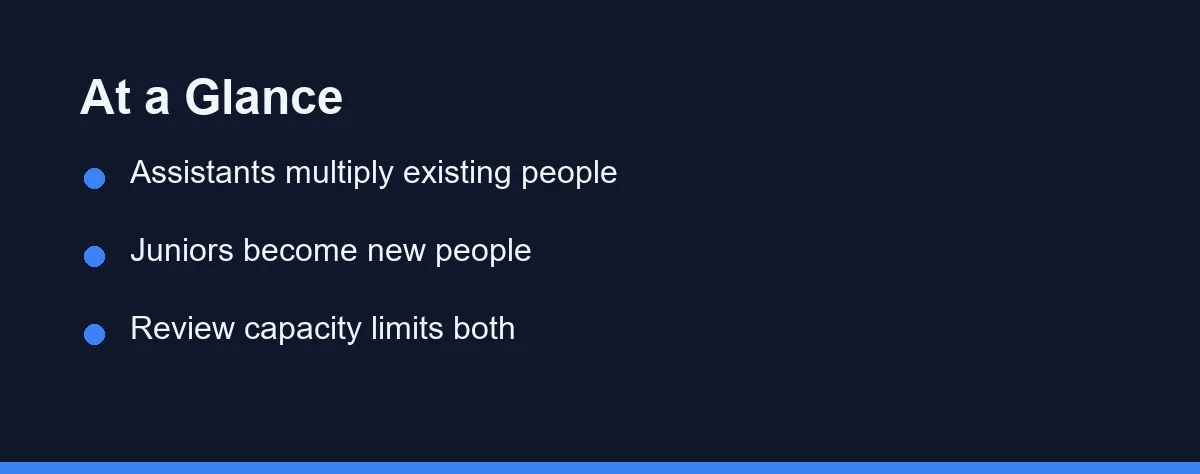
An AI coding assistant multiplies the output of engineers you already have. A junior developer adds a person who can own work, take a rotation, and become a senior in two or three years.
If your problem is that skilled people spend their days on boilerplate, tests, and glue code, tools address it directly and immediately. If your problem is that one person holds all the context and takes holidays, no subscription fixes that.
Most small teams should buy the tools first, because the commitment is small and the answer arrives within weeks. Hiring is the right move when the missing thing is capacity to own, not capacity to type.
The two also stack. A junior with a good assistant and a patient reviewer ramps faster than the same junior alone.
What You Are Actually Buying in Each Case
Buying an assistant gets you speed on well-defined work. Scaffolding, tests, refactors, documentation, and unfamiliar syntax all move faster, and the effect is largest for engineers who already know what they want.
You also buy availability. The tool works at midnight, does not need onboarding, and scales to zero when the sprint is quiet.
Hiring a junior gets you something categorically different. You get a second brain that accumulates context about your product, your customers, and the reason a strange workaround exists in the billing module.
You also get obligations. Onboarding, code review, career conversations, and the risk that the person leaves after a year all come with the role, and none of them show up on a pricing page.
Throughput, Review Load, and the Hidden Bottleneck
Both options increase the volume of code arriving for review, and that is where small teams break.
An assistant can generate a large pull request in an afternoon. A junior can too, for different reasons. In both cases the reviewer is the same overworked senior engineer who wanted relief in the first place.
Teams that skip this step get a predictable outcome. Merge velocity rises for a month, defect rates follow, and the senior engineer ends up rewriting work they never had time to review properly.
The practical rule is to measure review capacity before adding throughput. If a single person reviews everything and already has a queue, that queue is your constraint, and neither option helps until you widen it.
Cost and Capability Side by Side
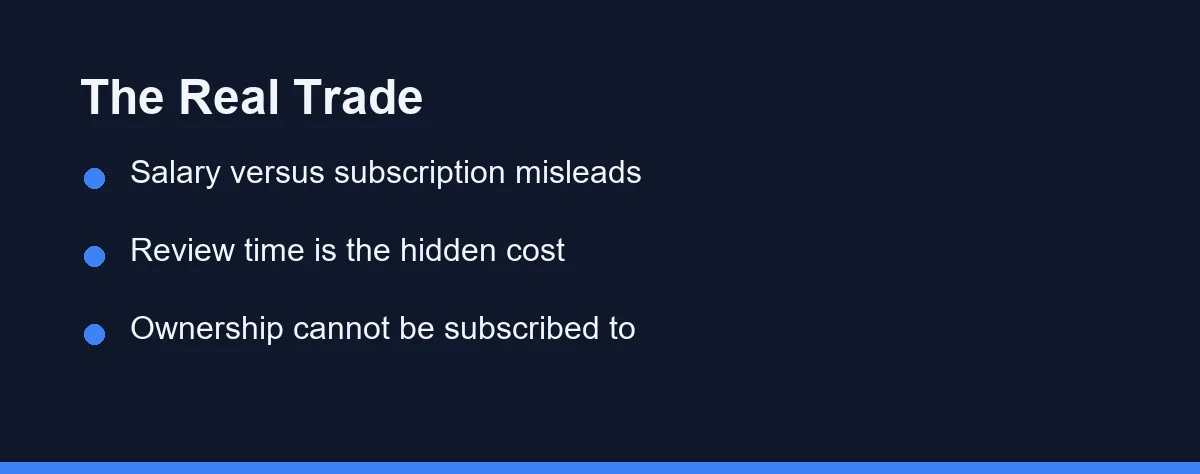
The table compares the four routes a small team realistically considers. Confirm current pricing on each vendor’s official site, since plans and seat rules change at the time of writing.
| What you need | AI assistant | Junior developer | Contractor | Senior hire |
|---|---|---|---|---|
| Immediate output on defined tasks | High | Low at first | High | High |
| Cost commitment | Monthly, cancellable | Salary, long term | Project-based | Salary, highest |
| Adds review capacity | No | Not for a year | Sometimes | Yes |
| Accumulates product context | No | Yes, permanently | No, leaves with them | Yes |
| Can be on call | No | Eventually | Rarely | Yes |
| Time before net positive | Days | Three to six months | Weeks | Weeks |
| Risk if it does not work | Cancel the plan | Difficult and slow | End the contract | Difficult and slow |
| Helps during an incident | Marginally | Sometimes | Rarely | Yes |
The row about time to net positive explains most disappointment with junior hires. A junior is an investment that pays back after the ramp, and teams under acute pressure often hire into a window where they cannot afford the ramp.
The bottom row explains most disappointment with tooling. Assistants contribute little at three in the morning when a queue is backing up and nobody knows why.
What a Junior Developer Gives You That No Model Does
Continuity is the first thing. A person who has been in the codebase for a year knows which module lies about its own behaviour, and that knowledge compounds.
Judgement about your context is the second. Deciding whether a bug is worth fixing this week requires knowing the customer who reported it, which is exactly the information a model does not hold.
Ownership is the third and the most underrated. Someone accountable for a service behaves differently from a tool that produces a suggestion and forgets it.
Growth is the fourth. Teams that never hire juniors eventually face a market where every senior costs more than the last, and they have no internal pipeline to draw on.
Which Choice Fits Your Team Right Now
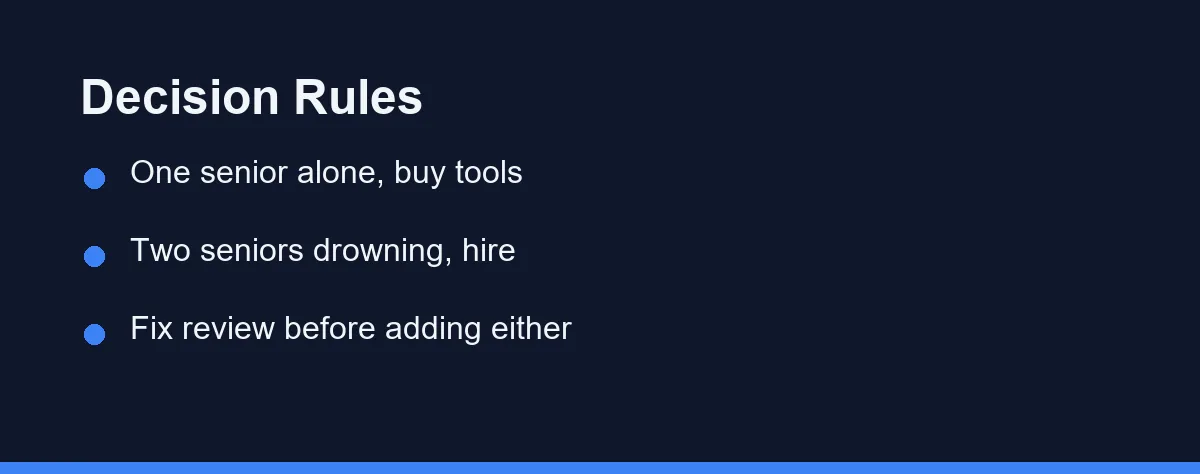
One senior engineer carrying everything: Buy tools now, and plan a hire for later. Adding a junior to a team with no review capacity creates two overloaded people rather than one.
Two or three engineers with a growing review queue: Hire, and treat the tools as a supplement. Your constraint is people who can approve work, and only a person fixes that.
Team shipping a well-understood product with lots of boilerplate: Tools, decisively. This is the shape of work assistants handle best, and our team assistant guide covers rollout details.
Startup before product-market fit: Tools, and stay flexible. A salary commitment is hard to reverse when the roadmap changes every six weeks.
Agency with fluctuating client work: Tools plus contractors. Junior hiring works badly when utilisation swings, because the ramp needs steady work to complete.
Company with a bus factor of one: Hire, even if it feels expensive. Every month you delay, the risk concentrates further, and no subscription reduces it.
Budgeting for Either Path
Neither option costs what it appears to cost, so budget for the second-order items as well.
| Cost line | Assistant route | Junior hire route |
|---|---|---|
| Direct spend | Per seat, monthly | Salary and employment costs |
| Setup effort | Days, mostly configuration | Weeks of onboarding |
| Ongoing senior time | Review of generated code | Review, mentoring, and pairing |
| Tooling for the new person | Not applicable | Licences, hardware, accounts |
| Risk cost | Low, cancel anytime | High, slow to unwind |
| Payback horizon | Immediate to weeks | Two to four quarters |
The line that decides most real budgets is ongoing senior time. Both routes spend it, and teams routinely count the money while ignoring the hours.
If you want a structured way to pick the tool itself, our guide to choosing an assistant for a small team walks through the evaluation.
The Combination Most Teams Land On
The steady state for a small engineering team is not one or the other. It is a junior with tools and a review process that can absorb their output.
That combination works because it addresses both constraints. The tools remove the drudgery that made the junior slow, and the junior grows into the reviewer that the tools made necessary.
Sequencing matters more than the mix. Buy tools in the quarter you feel the drudgery, and hire in the quarter you feel the single-point-of-failure risk.
Set the expectation explicitly when you do hire. A junior using an assistant should read and explain more code than they generate, which is where the evidence on AI pair programming and code quality becomes relevant to how you mentor.
Run the Cheap Experiment Before the Expensive One
Hiring is a decision you live with for a year, and tooling is a decision you can reverse in a month. That asymmetry argues for testing the cheap option first, with a real measurement attached.
Start by writing down what you expect to change. “Tickets in the boilerplate category close faster” is testable, and “the team will be more productive” is not.
Run it for four weeks with the whole team on the same tool, since a split trial produces arguments rather than evidence. Track three numbers: cycle time on the tasks you targeted, review turnaround, and defects escaping to production.
Read the result honestly at the end. If cycle time improved and review turnaround did not degrade, the tools solved a real constraint and hiring can wait a quarter.
If cycle time improved while review turnaround got worse, you have proof of the opposite. The constraint was never typing speed, and the next investment belongs in a person who can approve work.
There is one outcome worth naming in advance. Sometimes nothing measurable changes, which usually means the bottleneck sits outside engineering entirely, in unclear requirements or slow decisions.
Common Mistakes in This Decision
Framing it as a replacement is the first mistake. The two options overlap on typing speed and almost nowhere else.
Ignoring review capacity is the second, and it is the one that actually hurts. Throughput without review produces defects, and defects consume the time the investment was meant to free.
Hiring a junior as an emergency measure is the third. Acute pressure demands someone productive this month, which describes a contractor or a senior, not a junior.
Judging tools by a one-week trial is the fourth. The honest measure appears after a month, when you can see whether review load rose faster than shipped work.
Where This Leaves You
Ask which of two sentences describes your team. “We are slow at work we understand” points to tooling, and “only one person can do this” points to hiring.
Teams that answer both need both, in that order, spaced far enough apart to absorb each change.
The thing worth protecting through either choice is review. It is the constraint that decides whether extra output becomes shipped value or accumulated debt.
FAQ
Can an AI coding assistant replace a junior developer?
No, because they solve different problems. An assistant multiplies the output of someone who already knows the codebase, while a junior developer becomes a second person who can own work, join a rotation, and grow into a senior role. Teams that swap one for the other usually discover the gap during their first incident.
Is an AI coding assistant cheaper than hiring a junior?
Subscriptions cost a fraction of a salary, so the assistant wins that comparison easily. The comparison misleads, because the assistant produces code that still needs a reviewer, and review time comes out of your senior engineers rather than a budget line.
What is the real bottleneck when a small team grows?
Review capacity. Both options increase the amount of code arriving for review, and a team with one overloaded reviewer will choke on either. Fix the review bottleneck before you add either source of throughput.
Do junior developers still learn if they use AI assistants?
They still learn, and the learning changes shape. Juniors who lean on an assistant read more code and write less of it from scratch, so mentoring has to shift toward explaining why a suggestion is wrong rather than watching someone struggle to produce one.
Which should a small startup buy first?
Usually assistants first, because the commitment is small and reversible. Hiring makes sense when the work needs a second person who can carry a domain, respond out of hours, or take over when someone leaves, and no subscription provides that.
Some links may be affiliate links. We may earn a commission at no extra cost to you.
This article was written with AI assistance. It is researched and fact-checked, not based on personal hands-on testing unless explicitly stated.
Comments
Post a Comment