Does AI-Generated Code Create License Risk for Your Project?
The Question That Arrives After the First Merge
A team adopts an assistant, ships faster for a month, then someone in a review meeting asks who owns the code. The room goes quiet, because nobody prepared an answer.
The question usually arrives too late to be comfortable. By then the generated code sits across dozens of files with no record of where it came from.
That awkward moment has a simple root. Two very different legal questions get compressed into one worry, and neither gets addressed properly.
This guide separates them, shows which parts of an assistant’s output carry real exposure, and lays out the controls a small team can put in place this week.
Two Different Questions Hiding in One
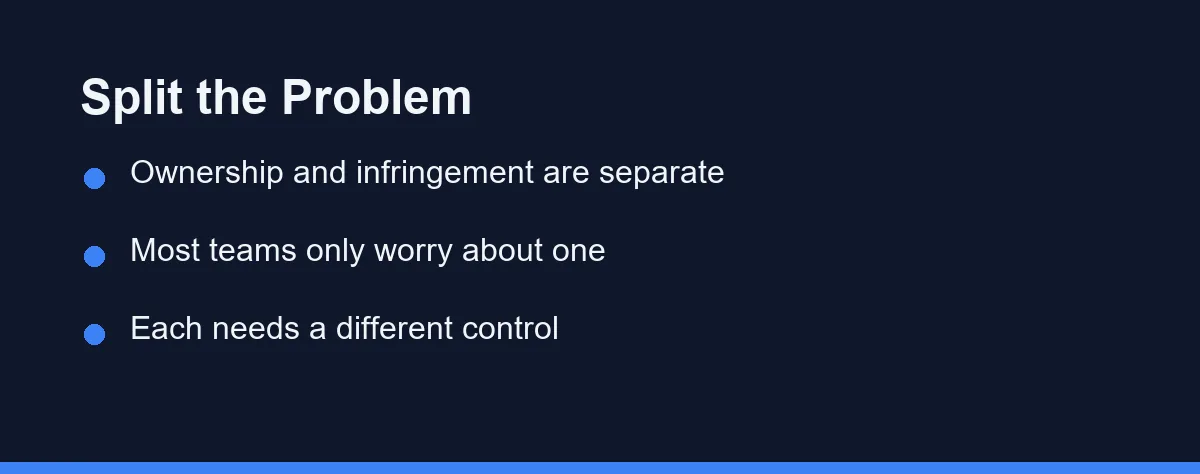
The first question is ownership. If a machine produced the code, can you claim copyright over it, and can you stop a competitor copying it?
The second question is infringement. Could the output reproduce somebody else’s licensed code closely enough to inherit that licence and its obligations?
These have opposite shapes. Ownership concerns what you can defend, while infringement concerns what somebody else could demand from you.
Most engineering teams worry loudly about the first and quietly ignore the second. Lawyers reviewing an acquisition tend to do the reverse, because obligations travel with the codebase.
Keeping the two apart makes the rest of this manageable. Different controls address each, and confusing them leads teams to buy protection they did not need.
What Ownership Means in Practice
Copyright protection generally requires human authorship. Several copyright offices have taken the position that output produced purely by a machine, without meaningful human contribution, falls outside that protection. The US Copyright Office’s January 2025 report goes further and concludes that prompts alone do not give users enough control to count as authors.
Real projects rarely sit at that extreme. A developer who prompts, edits, restructures, and integrates a suggestion has contributed human authorship to the finished work.
The practical effect is narrower than people fear. Your product does not become public property because an assistant helped write parts of it.
Where it bites is enforcement. A claim against a copycat becomes harder if you cannot show the human contribution behind the disputed section.
Vendor terms matter here too. Most major assistants assign whatever rights they hold in the output to the user, which removes the vendor as a competing claimant, and confirming your specific tier on the official terms page takes two minutes.
Where the Real Exposure Sits
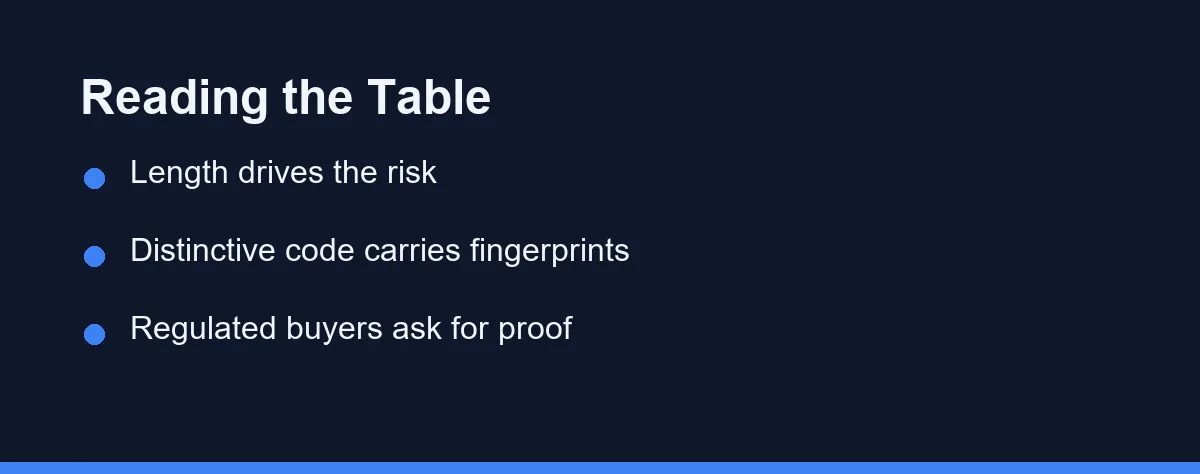
Infringement risk is not uniform across everything an assistant produces. It scales with length, distinctiveness, and how closely the output tracks a specific source.
| Type of output | Realistic risk level | Why | What to do about it |
|---|---|---|---|
| Boilerplate loops, null checks, getters | Very low | Only a handful of natural ways exist to express these | Nothing beyond normal review |
| Standard library and framework usage | Very low | Idiomatic patterns published in official documentation | Nothing beyond normal review |
| A 40 line function with unusual structure | Moderate | Length plus distinctiveness makes a match plausible | Enable matching filters, review before merge |
| A recognisable algorithm implementation | Moderate to high | Distinctive implementations often trace to one well-known source | Search for the source, rewrite or attribute |
| Whole files including comment blocks | High | Comments and formatting are strong fingerprints of a specific origin | Reject and rewrite from scratch |
| Configuration lifted from a niche project | Moderate | Niche configs have few sources, so origin is easy to trace | Verify the source project licence |
| Test fixtures containing sample data | Moderate | Sample data and fixtures can carry their own licences | Replace with data you generate |
The bottom half of that table is where audits find problems. Nobody has ever lost a deal over a generated null check.
Length is the single best proxy for risk. A suggestion long enough to feel impressive is long enough to be worth checking.
The Controls Vendors Give You
Most major assistants ship some form of public code matching control. The concept is consistent even where the naming is not, and each vendor documents the exact behaviour on its own site.
One approach blocks suggestions that match public repositories above a length threshold, so the risky output never reaches your editor. The threshold is usually measured in consecutive matching characters or lines.
GitHub’s documentation shows the scale involved. Copilot checks a suggestion plus about 150 characters of surrounding code against public GitHub repositories. GitHub says matches occur in less than 1% of Copilot suggestions.
Another approach lets the suggestion through and logs a reference to the matching repository and its licence. GitHub’s log lists the URLs of files containing matching code and the licence name, if one was found. That gives a developer the information needed to accept, rewrite, or attribute.
Enterprise tiers often add indemnification. The vendor agrees to defend certain third party claims, and that promise almost always depends on you keeping the matching filter enabled.
Read the conditions rather than the headline. Indemnity that lapses because a developer turned off a setting provides no protection at the moment it matters.
Check the settings you actually have deployed. Defaults differ between individual and business plans, and a team can run for months assuming a filter is on when nobody enabled it.
Our guide to what AI coding assistants see in your repository covers the neighbouring privacy question, which most teams review at the same time.
Attribution and the Copyleft Problem
Permissive licences such as MIT and Apache mostly ask for attribution. If generated code traces back to a permissively licensed project, the obligation is a notice file entry rather than anything structural.
Copyleft licences change the calculation. Reciprocal terms can require you to release derived source under the same licence, which is why a single unnoticed fragment can matter far beyond its size.
The realistic danger is not a lawsuit next month. It is a diligence review during an acquisition or an enterprise procurement, where an unexplained fragment stalls a deal for weeks.
Keeping an attribution log turns that crisis into a paragraph. Record what came in, from where, and under which licence, and the reviewer moves on.
Controls That Actually Reduce Exposure
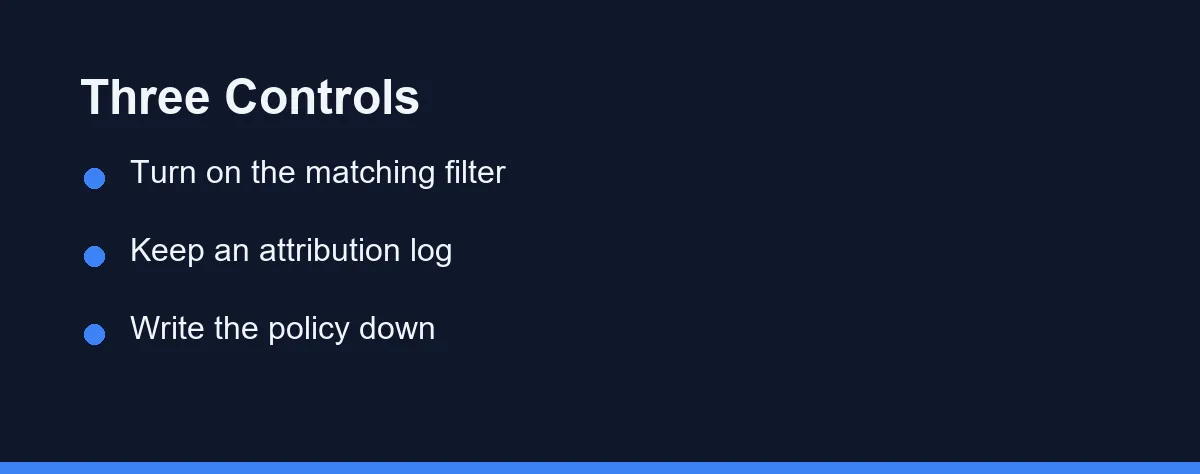
Start with the settings, because they cost nothing. Turn on public code matching for every seat, and verify it centrally rather than trusting each developer’s local configuration.
Write a one page policy next. Say which repositories are in scope, what happens when a match is flagged, and who decides between rewriting and attributing.
Add a review expectation for large suggestions. Any block over roughly thirty lines deserves a human read before merge, which our guide to reviewing AI-generated code breaks down into specific checks.
Keep the log somewhere durable. A file in the repository beats a chat message, since the person who needs it in two years will not be reading your old messages.
Treat the licence question as part of security review rather than a separate ritual. Teams that already run a dependency scan can fold this in, and our security checklist for AI-generated code covers the overlapping items.
Finally, date your notes. Vendor terms change several times a year, and a policy that names its review date ages honestly instead of quietly going stale.
Checking a Suspicious Block in Ten Minutes
Sometimes a suggestion arrives looking too complete. The check below costs a coffee break and settles most of these cases.
Take the most distinctive line and search it verbatim on a code host. Unusual variable names, specific constants, and odd comment wording are the parts that survive copying, so they make the best search terms.
Read the comments before the code. Generated comments tend to explain the obvious, while inherited ones often reference issue numbers, author names, or a project’s internal vocabulary.
Look at the structure for signs of a larger source. A helper function that calls something you never asked for, or an import you do not use, suggests the block came out of a bigger file.
Check your assistant’s reference log if it keeps one. A logged match names the repository and licence directly, which turns a research question into a decision.
Then decide between three outcomes. Accept a short generic block, rewrite anything distinctive in your own structure, or keep it and record the attribution properly.
Rewriting is faster than most developers expect. Once you understand what the block does, expressing it in your own style takes minutes, and it removes the question permanently.
What a Diligence Reviewer Asks
Knowing the questions in advance shapes what you record today. Reviewers work through a predictable list during an acquisition or an enterprise procurement.
They ask which assistants your team uses and on which plans. Individual seats without administrative controls raise more follow-up questions than enterprise seats do.
They ask whether public code matching was enabled and how you know. An answer that names a centrally enforced setting closes the topic, while an answer based on trust does not.
They ask for your policy document and its date. A one page policy reviewed six months ago reads far better than a longer one written the week before the review.
They ask about third party code generally, not just AI output. Dependency licences, vendored libraries, and pasted snippets all sit in the same category, and our guide to auditing what your assistant can access overlaps with the questions they ask about data flow.
None of these questions is hard when the answers already exist. All of them are painful to answer retroactively across a codebase with no records.
Who Should Worry, and How Much
The solo developer on a side project: Turn the matching filter on and move on with your day. Your realistic exposure is close to zero, and an hour of policy writing buys you nothing.
The startup expecting to raise or sell: Start the attribution log now, because retrofitting one during diligence is painful. Buyers ask about provenance as a matter of routine.
The agency shipping client work: Your contracts likely promise the client clean ownership of deliverables. Confirm what you can honestly warrant before signing, and keep the log per client.
The regulated enterprise team: You need the enterprise tier, the indemnity, and centrally enforced settings. Individual seats without administrative control will not survive an audit.
The open source maintainer: Contributor terms deserve an explicit line about AI-assisted contributions. Ambiguity here creates disputes that outlive the pull request.
The team writing an internal tool: Moderate care is enough, though the code rarely stays internal forever. Apply the same filter settings so that a later open sourcing decision does not force an archaeology project.
Mistakes That Turn a Small Risk Into a Real One
Assuming vendor indemnity covers everything is the first. Coverage is conditional, tier dependent, and narrower than the marketing page suggests.
Disabling the matching filter for convenience is the second. Developers do this when suggestions feel blocked too often, and the setting rarely gets turned back on.
Treating the assistant as the only source of risk is the third. Copied Stack Overflow answers and pasted snippets from blog posts carry the same questions, and they predate every AI tool by a decade.
The last mistake is waiting for a lawyer to raise it. The controls that matter are engineering decisions, and they take an afternoon to put in place before anyone asks.
FAQ
Can I even copyright code that an AI assistant wrote for me?
Copyright law in most countries protects work created by a human author, and several offices have said purely machine-generated output does not qualify. That mainly affects whether you can stop someone copying your generated code. It is a separate question from whether the output resembles somebody else's licensed code.
Do these tools have a filter for code that matches public repositories?
Some assistants offer a setting that blocks suggestions matching public code above a length threshold, and others log a reference when output resembles a known repository. Names and defaults differ by vendor, so confirm the current behaviour on the official documentation for your tool.
Does my vendor indemnify me if a claim arrives?
Several vendors offer indemnity on paid business tiers, usually conditional on having the matching filter enabled and on following their usage terms. Coverage varies widely and changes often, so read the current agreement rather than a summary written last year.
Is a three line suggestion really a licensing problem?
Short idiomatic fragments carry little risk, since there are only so many ways to write a loop or a null check. Risk rises with length, with unusual structure, and with anything that reproduces a distinctive algorithm or a full file of comments intact.
What should a small team actually write down?
Yes, and this is the practical part most teams skip. A short written policy covering the matching filter, review expectations, and which repositories are off limits protects you far more than any tool setting on its own.
Sources
- SPDX License List — checked 2026-09-10
- GitHub Docs: GitHub Copilot code referencing — checked 2026-10-03
- US Copyright Office: Copyright and Artificial Intelligence, Part 2: Copyrightability — checked 2026-10-03
Some links may be affiliate links. We may earn a commission at no extra cost to you.
This article was written with AI assistance. It is researched and fact-checked, not based on personal hands-on testing unless explicitly stated.
Comments
Post a Comment